

The Health Benefits of Sauna Bathing | Research Guide
Sweating for Longevity: The Science-Backed Health Benefits of Regular Sauna Bathing
A Comprehensive Review of Passive Heat Therapy, Cardiovascular Protection, Cognitive Resilience, and Performance Enhancement
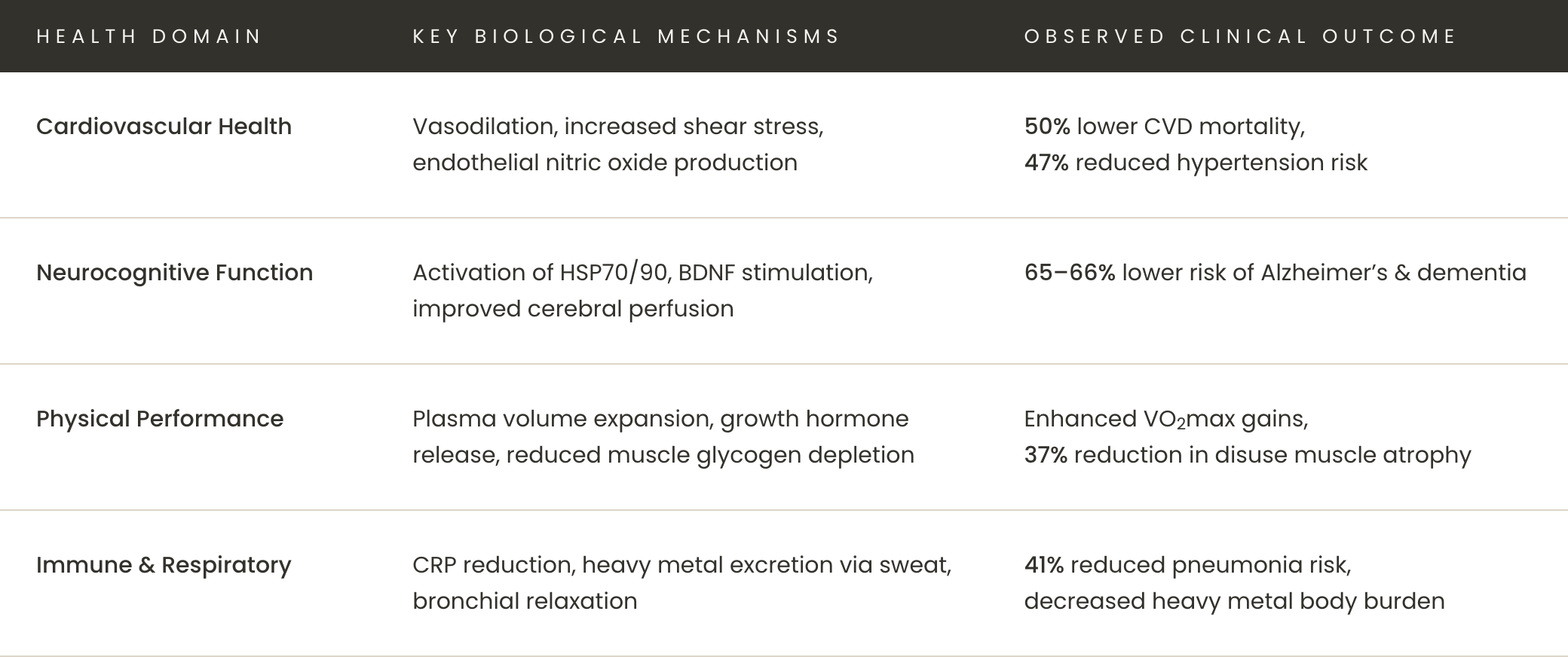
Regular sauna bathing acts as an exercise mimetic, inducing physiological stress (hormesis) that triggers profound systemic adaptations. Clinical trials and prospective cohorts demonstrate that frequent sauna use (4–7 times per week) reduces cardiovascular disease mortality by 50%, all-cause mortality by 40%, and dementia/Alzheimer's risk by 65–66%.
For thousands of years, thermal bathing has served as a cornerstone of hygiene, relaxation, and physical wellness across diverse human cultures. From traditional Finnish log saunas to modern far-infrared cabins, passive heat therapy has evolved into a powerful lifestyle intervention in preventive medicine. Far from being a mere luxury, regular sauna bathing triggers physiological adaptations that closely mimic moderate-to-vigorous aerobic exercise.
When you step into a sauna, your core body temperature rises, initiating autonomic, cardiovascular, and cellular responses. Heart rate increases to 120–150 beats per minute, cardiac output expands, and blood vessels dilate to route warm blood to the skin for evaporative cooling. This therapeutic heat stress—known as hormesis—promotes cellular repair and builds resilience against future physiological strain. Over the past decade, prospective cohorts and clinical trials have shown that routine thermal exposure improves cardiovascular health, brain function, physical performance, immune defense, and overall longevity.
Cardiovascular Health and Lifespan Extension
The most compelling research supporting sauna bathing centers on cardiovascular protection and all-cause mortality. Data from the Kuopio Ischemic Heart Disease (KIHD) study, a landmark prospective cohort tracking over 2,300 Finnish men for two decades, demonstrated a clear, dose-dependent relationship between sauna frequency and reduced risk of death.
Compared to men bathing once weekly, those using the sauna 4 to 7 times per week experienced:
63% lower risk of sudden cardiac death.
48% lower risk of fatal coronary heart disease.
50% lower risk of fatal cardiovascular disease.
40% lower risk of all-cause mortality.
Session duration is equally vital: stays exceeding 19 minutes conferred greater cardiac protection than sessions under 11 minutes. Frequent sauna use also lowers the long-term risk of developing hypertension by 47%. Even a single 30-minute session acutely lowers blood pressure while improving arterial compliance and reducing arterial stiffness.
For clinical populations, far-infrared sauna therapy (Waon therapy) serves as an effective adjunct treatment. In patients with chronic heart failure, repeated 15-minute sessions at 60°C improve left ventricular ejection fraction, enhance endothelial flow-mediated dilation, lower B-type natriuretic peptide levels, and reduce cardiac enlargement.
Neurocognitive Protection and Mental Well-Being
Sauna bathing offers extraordinary protection against age-related cognitive decline. The KIHD study revealed that men using a sauna 4 to 7 times per week had a 66% lower risk of dementia and a 65% lower risk of Alzheimer’s disease compared to once-weekly bathers.
These neuroprotective benefits stem from several biological mechanisms:
Heat Shock Proteins (HSPs): Thermal stress upregulates chaperones like HSP70 and HSP90, which repair misfolded proteins and clear cellular debris, preventing toxic amyloid-beta plaque aggregation associated with Alzheimer's disease.
Neurogenesis and BDNF: Heat exposure stimulates Brain-Derived Neurotrophic Factor (BDNF), promoting neurogenesis and neuroplasticity in memory centers like the hippocampus.
Cerebral Perfusion: Improved endothelial function and reduced arterial stiffness ensure robust blood flow to brain tissue, supporting waste clearance and nutrient delivery.
Mental health benefits are equally profound. Sauna sessions trigger beta-endorphins and modulate opioid receptors, inducing an euphoric post-sauna state. Electroencephalography (EEG) studies show that hot-cold-rest cycles induce the "totonou" state—a state of deep neural relaxation with heightened alpha and theta brain wave activity and heightened cognitive efficiency. Clinical trials demonstrate reduced depressive symptoms, while long-term cohort data link frequent use to a 77% reduced risk of psychotic disorders.
Physical Fitness, Muscle Preservation, and Synergy with Exercise
Athletes utilize saunas to accelerate recovery and enhance endurance performance. Termed hyperthermic conditioning, deliberate heat exposure expands plasma volume (by up to 7.1%) and increases red blood cell count. This optimizes oxygen delivery to active tissues, reduces cardiovascular strain, and decreases muscle glycogen depletion during strenuous workouts.
Sauna bathing also preserves lean muscle mass:
Growth Hormone Surge: Thermal exposure stimulates growth hormone release—ranging from a 2-fold increase after moderate sessions to a 16-fold surge after repeated daily exposures.
Attenuating Muscle Atrophy: HSP induction reduces oxidative stress and inhibits protein degradation, attenuating muscle atrophy during disuse or injury by up to 37%.
Heat therapy acts synergistically with exercise. An 8-week randomized controlled trial revealed that adding a 15-minute sauna session after regular exercise produced significantly greater gains in VO2max (cardiorespiratory fitness), larger reductions in systolic blood pressure, and greater drops in total cholesterol than exercise alone.
Immune Resilience, Respiratory Health, and Detoxification
Regular thermal exposure strengthens immune defenses and protects respiratory health. Frequent sauna users exhibit lower C-reactive protein (CRP) levels, reflecting reduced chronic systemic inflammation. Bathing 4 to 7 times weekly reduces pneumonia risk by 41% and lowers the incidence of common colds, asthma exacerbations, and chronic obstructive pulmonary disease events.
Additionally, heavy sweating serves as an excretory route for environmental toxicants. Sweat excretes heavy metals—including cadmium (25-fold higher rate than urine), lead (17-fold), cobalt (7-fold), and aluminum (3.75-fold)—as well as lipophilic petrochemicals.
Optimal Protocols and Safety Guidelines
To maximize physiological benefits safely, public literature supports the following evidence-based guidelines:
Traditional Finnish Sauna: Maintain temperatures between 80°C and 100°C (176°F–212°F) with 10%–20% humidity for 15 to 20 minutes per session.
Infrared Sauna: Use temperatures between 45°C and 60°C (113°F–140°F) for 15 to 30 minutes.
Frequency: Target 4 to 7 sessions per week for optimal healthspan and longevity benefits.
Hydration: Drink ample water before and after sessions to offset fluid loss.
Safety Precautions: Strictly avoid alcohol before or during sauna use, as it markedly increases the risk of hypotension, arrhythmias, and sudden cardiac events. Men attempting to conceive should note that high heat temporarily decreases sperm count and motility. Sauna use is contraindicated for unstable angina, recent myocardial infarction, severe aortic stenosis, or decompensated heart failure.
Summary of Health Benefits & Key Parameters
Conclusion
Integrating regular sauna bathing into your lifestyle is a proven strategy to extend healthspan. By triggering cellular adaptations that mimic exercise, heat therapy protects the heart, sharpens cognition, preserves muscle, and fortifies immune resilience. Whether used post-workout or as a daily wellness ritual, the sauna provides a transformative path toward lifelong vitality.
References & Public Peer-Reviewed Literature
Hussain J, Cohen M. Clinical Effects of Regular Dry Sauna Bathing: A Systematic Review. Evid Based Complement Alternat Med. 2018;2018:1857413.
Patrick RP, Johnson TL. Sauna use as a lifestyle practice to extend healthspan. Exp Gerontol. 2021;154:111509.
Laukkanen JA, Laukkanen T, Kunutsor SK. Cardiovascular and Other Health Benefits of Sauna Bathing: A Review of the Evidence. Mayo Clin Proc. 2018;93(8):1111–1121.
Kukkonen-Harjula K, Kauppinen K. Health effects and risks of sauna bathing. Int J Circumpolar Health. 2006;65(3):195–205.
Laukkanen T, Khan H, Zaccardi F, Laukkanen JA. Association Between Sauna Bathing and Fatal Cardiovascular and All-Cause Mortality Events. JAMA Intern Med. 2015;175(4):542–548.
Zaccardi F, Laukkanen T, Willeit P, Kunutsor SK, Kauhanen J, Laukkanen JA. Sauna Bathing Is Inversely Associated With Dementia and Alzheimer's Disease in Middle-Aged Finnish Men. Age Ageing. 2017;46(2):245–249.
Lee E, Laukkanen T, Kunutsor SK, Khan H, Willeit P, Zaccardi F, Laukkanen JA. Sauna bathing reduces the risk of stroke in Finnish men and women. Eur J Prev Cardiol. 2018;25(2):130–138.
Kihara T, Biro S, Imamura M, Yoshifuku S, Takasaki K, Ikeda Y, Otuji Y, Minagoe S, Tei C. Repeated sauna treatment improves vascular endothelial and cardiac function in patients with chronic heart failure. J Am Coll Cardiol. 2002;39(5):754–759.
Chang M, et al. Neural changes induced by sauna bathing: Neural basis of the 'totonou' state. PLoS ONE. 2023;18(11):e0294137.
Scoon GS, Hopkins WG, Mayhew S, Cotter JD. Effect of post-exercise sauna bathing on the endurance performance of competitive male runners. J Sci Med Sport. 2007;10(4):259–262.
Lee E, Willeit P, Laukkanen T, Kunutsor SK, Laukkanen JA. Effects of regular sauna bathing in conjunction with exercise on cardiovascular function. Am J Physiol Heart Circ Physiol. 2022;323(3):H641–H650.
