Infrared Emitters vs. Traditional Sauna Heaters: Different Tools for Different Experiences
If you’ve spent any time shopping for a sauna, you’ve probably encountered two terms over and over again: traditional sauna and infrared sauna.
At first glance, they can seem like two different ways of accomplishing essentially the same thing. Both involve heat. Both can make you sweat. Both are marketed as wellness products.
But that’s where the similarities begin to end.
A traditional sauna heater and an infrared emitter are fundamentally different heating technologies. They heat the room and your body in different ways, operate at different temperatures, and create very different experiences.
At Sauna Bath Co., we work with traditional sauna heaters, infrared emitters, and hybrid rooms that incorporate both. Our goal isn’t to convince anyone that one technology is better than the other.
It’s to help you understand what each one actually does, so you can build the room you’ll enjoy using for years.
First, They Produce Heat Differently
The easiest way to understand the difference is to start with the equipment.
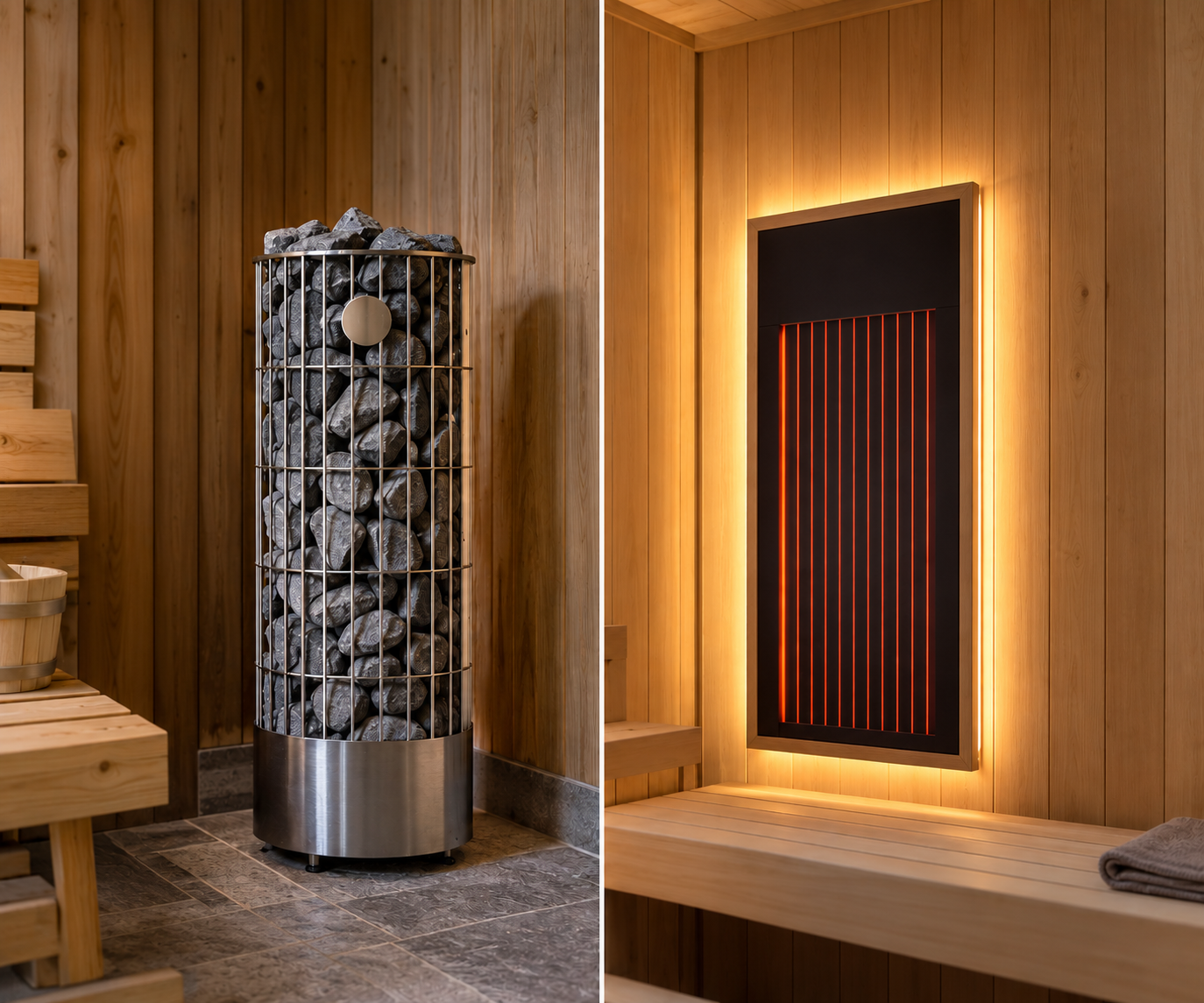
A traditional sauna uses a sauna heater and a substantial mass of sauna stones. The heater warms the stones and the surrounding air, creating the high-temperature environment most people associate with Finnish-style sauna bathing.
Those stones also serve another important purpose: they allow you to introduce water and create a burst of steam and humidity created when water is poured over hot sauna stones.
That means you control two important parts of the experience: Temperature and humidity.
You might enjoy a relatively dry sauna one day and add more water to the stones the next. That ability to manipulate heat and humidity is a defining part of traditional sauna bathing.
Infrared works differently.
Instead of a sauna heater and stones, an infrared room uses emitters or panels that produce radiant infrared energy. Rather than relying primarily on very hot room air, those emitters transfer radiant heat to your body and the surfaces around you.
The result is a lower-temperature, dry heat experience.
Same general idea in that they both use heat intentionally.
Just very different ways of getting there.
The Experience Is Different, Too
Traditional saunas commonly operate somewhere in the neighborhood of 150°F to 200°F, depending on the sauna, heater, bathing style, and personal preference.
Infrared rooms generally operate at considerably lower ambient temperatures, often around 110°F to 140°F.
That difference matters.
If what you imagine when you hear the word sauna is stepping into an intensely warm wood-lined room, sitting on an upper bench, pouring water over hot stones, and feeling that wave of heat and steam roll through the room, you’re describing a traditional sauna experience.
Infrared isn't trying to reproduce that experience.
Its appeal is different.
Some people simply prefer a lower-temperature environment. They like sitting in gentle, dry radiant heat without the intensity of a 180°F sauna or the humidity created by water on the stones.
Neither preference is wrong.
But buying one technology while expecting the experience of the other is where disappointment starts.
An Infrared Room Isn't Just a Cooler Sauna
This distinction is important enough that we prefer to call these spaces infrared rooms or infrared cabins, rather than infrared saunas.
That isn't meant to diminish infrared technology. It’s simply a more accurate way to describe what you're buying.
Traditional sauna has a long cultural history built around a particular environment: a heated room, sauna stones, elevated temperatures and the ability to introduce water onto those stones.
Infrared creates heat using a different mechanism and produces a different bathing environment.
Think of them as two different tools designed to create two different experiences, rather than two versions of the same appliance.
Once you look at them that way, deciding between them becomes much easier.
Where Infrared Makes Sense
There are applications where infrared can be a very good fit.
If you prefer lower temperatures, don't particularly enjoy steam, or simply like the sensation of radiant heat, a properly designed infrared room may be exactly what you're looking for.
Infrared has also been studied as a form of heat therapy, including research involving cardiovascular and rheumatologic conditions. However, the research base is smaller and more varied than the long-term research associated with traditional Finnish sauna bathing, and current evidence isn't strong enough to prescribe one type of sauna over another for a particular medical condition.
That distinction is important.
We'd rather help customers choose infrared because they understand and prefer the experience, rather than because of an exaggerated health claim.
Where Traditional Sauna Shines
For someone looking for the complete sauna experience, traditional is difficult to replicate.
You get higher temperatures.
You get a sauna heater and stone mass.
You get enveloping steam.
You control the humidity.
And you get something that is easy to overlook when comparing specifications online: the ritual and social experience of sauna bathing.
A well-designed sauna isn't simply a heated box.
It's a room where you can sit with your partner at the end of the day. A place where friends gather without phones and televisions. A quiet space where there isn't much to do except slow down, warm up, and talk.
That experience is one of the reasons sauna has remained part of daily life in cultures such as Finland for generations.
It's also something we see with our customers. Once people experience a properly designed traditional sauna: correct bench heights, good ventilation, an appropriately sized heater, a generous stone mass and the ability to create immersive steam, they often understand immediately why the experience is different.
Traditional Sauna Also Has the Deeper Research History
If health and wellness research is important to your decision, it's worth understanding another distinction.
Some of the most compelling long-term sauna research has examined traditional Finnish sauna bathing.
One widely cited prospective study published in JAMA Internal Medicine followed 2,315 middle-aged Finnish men for a median of roughly 21 years. More frequent sauna bathing was associated with lower risks of sudden cardiac death, fatal coronary heart disease, fatal cardiovascular disease and all-cause mortality.
Importantly, this was an observational study, so it demonstrates an association rather than proving that sauna use caused those outcomes.
There is research involving infrared heat as well, and systematic reviews have identified potentially beneficial effects from both Finnish-style and infrared sauna use. But researchers have also concluded that more evidence is needed to determine whether particular types of sauna bathing should be recommended for specific health outcomes.
That's why we're careful about making any sweeping medical claims.
Sauna bathing has an interesting and growing body of research behind it. But your first question when designing a sauna should still be much simpler:
What type of heat experience will make you want to use this room regularly?
Quality Matters With Infrared Emitters
If infrared is the right choice for you, the quality of the emitters deserves important consideration.
Infrared products range from inexpensive mass-market cabins to sophisticated systems from established manufacturers. They are not interchangeable.
Look beyond claims about maximum temperature and ask about the actual emitter technology, construction quality, controls, electrical components, warranties, testing, and manufacturer.
You'll also see considerable discussion about electromagnetic fields, or EMF, when researching infrared products. Rather than treating “low EMF” as a marketing slogan or assuming that the presence of EMF automatically makes a product unsafe, we recommend looking for transparent manufacturer testing and documented specifications.
This is one of those places where buying solely on price can be shortsighted.
There is a short list of brands we trust, Sauna360 and Sunlighten among them. Sunlighten holds patents on their technology that specifically keeps EMF levels low. When we build a hybrid, that's the caliber of emitter we use, precisely because the technology behind them is designed to be safe. Be leery of the infrared rooms at the pool store and the big-box websites, and pay attention to what's actually inside the panels.
If infrared is going to be part of a room you'll use several times each week for years, the technology behind the wall matters.
Outdoor Sauna? That's Another Important Consideration
For those of us who live in colder climates, there is another practical difference.
Traditional sauna is exceptionally well suited to outdoor installations.
An appropriately designed electric or wood-burning sauna can be enjoyed throughout winter, even when temperatures outside are well below freezing.
In fact, that's part of the appeal.
Walking across the snow on a Michigan winter evening and stepping into a properly heated sauna is an experience all its own.
Infrared systems generally work best in more controlled indoor environments because they operate at lower room temperatures and rely on radiant emitters rather than the heating capacity of a traditional sauna stove.
If an outdoor sauna is part of your vision, that can significantly influence which heating technology makes sense.
And Sometimes the Right Answer Is Both
You don't necessarily have to choose.
We design hybrid saunas that incorporate a traditional sauna heater and infrared emitters into the same properly designed room.
That can be an excellent solution for households where different people enjoy different heat experiences.
One evening you might turn on the infrared emitters for a lower-temperature, dry session.
Another evening you might fire up the traditional heater, bring the room to temperature and enjoy steam.
It's particularly useful when one person is convinced they want infrared while someone else wants a traditional sauna.
Instead of compromising, one well-designed room can accommodate both.
Start With the Experience, Not the Technology
When customers ask us whether they should choose infrared or traditional sauna, we don't think the best answer starts with a specification sheet.
It starts with a few questions.:
What do you want the room to feel like?
Do you enjoy intense heat?
Do you want to pour water over the stones?
Do you prefer lower-temperature radiant heat?
Will you sauna alone, or do you envision using the space with family and friends?
Do you want the sauna indoors or outdoors?
And perhaps most importantly: Have you actually experienced both?
Before investing thousands of dollars in either one, we strongly recommend spending time in a properly designed traditional sauna and, if possible, a quality infrared room.
Don't just compare temperatures and marketing claims. Sit in them. Experience the heat. See which one makes you want to stay.
Because the best sauna, or infrared room, isn't the one with the longest list of features. It's the one you'll look forward to using.
At Sauna Bath Co., that's how we approach every project. Traditional sauna, infrared, or a hybrid of the two: start with how you want to use the space, understand what each technology actually does, and then design the room around the experience you want to create.
Sources / References
Laukkanen T, Khan H, Zaccardi F, Laukkanen JA. Association Between Sauna Bathing and Fatal Cardiovascular and All-Cause Mortality Events. JAMA Internal Medicine. 2015;175(4):542–548. doi:10.1001/jamainternmed.2014.8187
Hussain J, Cohen M. Clinical Effects of Regular Dry Sauna Bathing: A Systematic Review. Evidence-Based Complementary and Alternative Medicine. 2018;2018:1857413. doi:10.1155/2018/1857413