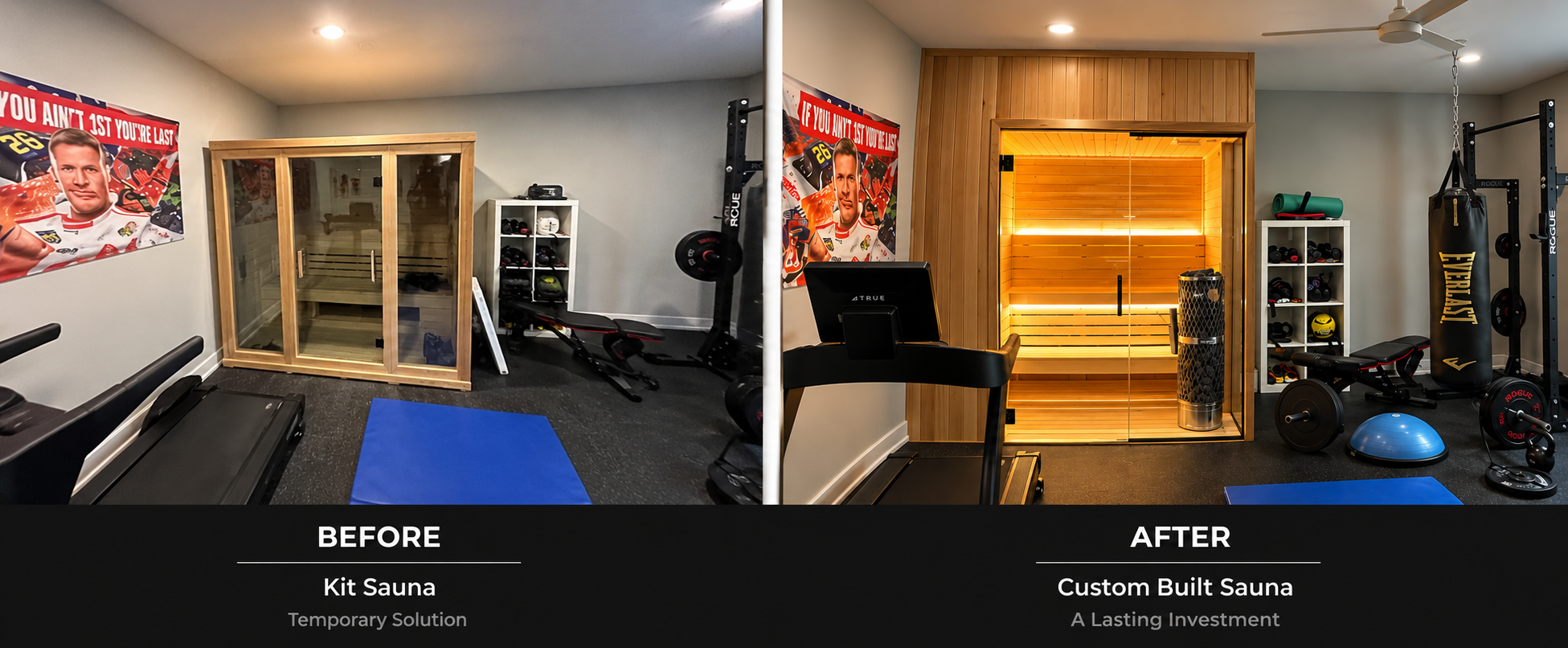
Kit vs. Custom Saunas
Choosing the Right Fit for Your Home and Lifestyle
Whether you’re an experienced sauna bather or just beginning to explore the practice, shopping for a sauna can raise a lot of questions. You might find a ready-to-assemble model at a big-box store for a relatively modest price - or commission a custom sauna that costs considerably more. Both are called saunas, so what accounts for the difference?
The short answer is that kit and custom saunas are designed to meet different needs. We recommend both, depending on the application. The right choice comes down to your space, climate, budget, expectations, and where you are in your sauna journey.
Here’s how to think about it.
What is a Kit Sauna?
A kit sauna is a pre-engineered package produced in standard sizes and configurations. Depending on the manufacturer, it may be made in Asia, Europe, North America, or elsewhere.
Most kits include preassembled or ready-to-assemble wall panels, benches, a door, and a heater. The materials, layout, dimensions, and available accessories are generally predetermined, although some manufacturers offer a limited range of options.
This standardized approach is one of a kit sauna’s biggest advantages. It simplifies the buying process, shortens installation time, and can make sauna ownership accessible at a lower initial cost. In many cases, the finished sauna is also freestanding, which may allow it to be relocated later.
Kit quality varies considerably. Entry-level models make up a large part of the market, but there are also well-designed premium kits made with quality materials. At the higher end, however, kit pricing approaches and may exceed the cost of a custom sauna. At that point, it is worth comparing not only the price, but also what each option provides in fit, performance, durability, and design flexibility.
When Does a Kit Sauna Make Sense?
For many first-time buyers, a kit is a smart place to start.
Consider someone who is curious about sauna bathing but has never owned a sauna. They may live in a condominium, expect to move within a few years, or simply want to find out how often they will use it before making a larger investment.
In that situation, building a permanent sauna into the home may not make sense. A well-chosen kit offers a practical way to experience sauna bathing with a smaller financial and logistical commitment.
Many people begin with an entry-level sauna, discover that the practice becomes an important part of their routine, and later decide to upgrade. There is nothing wrong with that path. We would rather see someone begin with an appropriate kit and fall in love with sauna bathing than abandon the idea because a custom build is not yet practical.
Where Kit and Custom Saunas Begin to Differ
Once you look beyond the initial price, the primary differences are:
Design flexibility
Freestanding versus built-in construction
Insulation and energy efficiency
Interior space, accommodation, and comfort
Heater and stone capacity
Material quality
Durability and service life
The importance of each factor depends on where the sauna will be installed and how it will be used.
Construction and Cold-Weather Performance
Construction becomes especially important when selecting an outdoor sauna for a northern climate.
Michigan winters place significant demands on a sauna. The enclosure must heat up efficiently, retain heat, and perform consistently when outdoor temperatures fall well below freezing.
Kit construction varies by manufacturer. Some models use solid-wood walls, while others use insulated or uninsulated panels. Entry-level outdoor kits may have thinner walls, less insulation, or simplified roof assemblies to reduce manufacturing and shipping costs. These choices can affect heat-up time, temperature stability, energy use, comfort and overall performance during cold weather.
A properly designed custom outdoor sauna is typically constructed much like a small building. It may include framed walls, appropriate insulation, weather-resistant exterior materials, and a roof assembly designed for the local climate. The heater is then selected according to the room’s size, construction, and amount of glass or other non-insulated surface area.
That does not mean every kit will perform poorly in winter. It does mean that buyers in cold climates should look carefully at wall construction, insulation, roof design, weatherproofing, and heater sizing - not just the sauna’s exterior dimensions and advertised capacity and maximum temperature.
Space, Comfort, and How You Plan to Use It
Kit saunas tend to have compact footprints. That can be an advantage when space is limited, but it may also mean shallower benches, less room to lie down, and tighter seating for multiple people.
Before choosing a sauna, think beyond the number of occupants listed in the product description. Ask how you actually want to use the room:
Do you prefer to sit or lie down?
Will you usually sauna alone, with a partner, or with family and friends?
Do you want room for stretching or gentle movement?
Is the social side of sauna bathing important to you?
Will you need a changing room, shower area, or space to cool down?
A sauna described as accommodating four people may technically provide four seats without giving four adults much room to relax. Bench depth, bench length, ceiling height, and the relationship between the benches and heater all affect comfort.
A custom sauna can be designed around those details. If you want two people to lie down, room for hot yoga or stretching, a particular view, or seating that supports larger gatherings, those requirements can be incorporated from the beginning.
Heater Size is Only Part of the Story
People often focus on maximum temperature when comparing sauna heaters. Temperature matters, but it does not tell the whole story.
A properly selected heater should be capable of bringing the sauna to an appropriate bathing temperature. The overall experience, however, is also influenced by the room’s insulation, air circulation, heater design, stone capacity, and the way the heater produces steam.
Entry-level wall-mounted heaters may hold a relatively small amount of sauna stones. Larger heaters hold substantially more. When water is poured over a small stone mass, it may produce a quick, sharp burst of steam. A larger, thoroughly heated stone mass creates a softer, fuller, and more sustained wave of enveloping steam.
Two saunas may display the same temperature on a thermometer and still feel very different. The distribution of heat, humidity, ventilation, and quality of the steam all contribute to the bathing experience.
The goal is not simply to choose the heater with the most stones. It is to select a heater that is properly matched to the room and to the experience you want.
Materials, Water, and Long-Term Durability
Material quality also affects how a sauna performs over time.
A sauna is exposed to repeated cycles of heat, moisture, and cooling. In areas with mineral-rich or otherwise challenging water (many areas of Michigan), heater components may face additional wear. The grade and placement of stainless steel and other corrosion-resistant materials can therefore make a meaningful difference in durability.
Regardless of price, every sauna requires proper use and maintenance. Water should be poured only on sauna stones and in accordance with the heater manufacturer’s instructions. Ventilation, drying, routine cleaning, and periodic inspection all help protect the room and its equipment.
Kit saunas can provide years of enjoyment when they are well made, properly installed, and appropriately maintained. Custom construction can offer a longer service life, but that depends on good design, suitable materials, skilled installation, and ongoing care. “Custom” alone is not a guarantee of quality.
What Does a Custom Sauna Provide?
The greatest advantage of a custom sauna is that it is designed for a particular space, household, and way of living.
You can determine:
The room’s dimensions and shape
Bench height, depth, and layout
Window placement and views
Lighting and controls
Wood species and accent materials
Heater type and stone capacity
Ventilation strategy
Interior and exterior finishes
Accessibility features
Changing, showering, or cooling spaces
Instead of adapting your needs to a predetermined product, the sauna is designed around how you intend to use it.
A custom indoor sauna can become an integrated part of the home rather than a freestanding unit placed in an available corner. When thoughtfully designed, it can complement the architecture and feel like it has always belonged there.
A custom outdoor sauna can be designed to coordinate with the home’s siding, roofing, and overall character. Its structure can also be engineered for the local climate and positioned to take advantage of a lake, woodland, garden, or other view.
For homeowners who plan to stay in their home and use the sauna frequently, those details can make a substantial difference in both the daily experience and the long-term value of the investment.
Which Sauna is Right for You?
A kit sauna may be the right choice if:
You are new to sauna bathing.
You want a lower initial investment.
You may move within the next few years.
You prefer a relatively quick or “DIY” installation.
Your available space fits a standard configuration.
You do not need extensive design flexibility.
A custom sauna may be the better choice if:
Sauna bathing is already an established part of your lifestyle or know that it will be.
You plan to use the sauna several times a week.
You want the sauna integrated into your home or property.
You have a challenging or unusual space.
You need specific seating, accessibility, or activity areas.
Cold-weather performance and efficiency is a high priority.
You want greater control over materials, appearance, heater performance, and long-term durability.
The Right Sauna is the One That Fits Your Life
Choosing between a kit and a custom sauna is not about declaring one category universally better than the other. It is about finding the right solution for the application.
For someone exploring sauna bathing, living in a temporary home, or working within a modest budget, a quality kit can be an excellent way to begin.
For someone building a long-term home, planning frequent use, or seeking a sauna designed around a specific space and experience, a custom build may be the better investment.
Some sauna bathers start with a kit and upgrade later. Others know from the beginning that they want a permanent, fully tailored space. Both are valid paths.
The goal is the same: a sauna that performs well, feels comfortable, and fits naturally into your life.